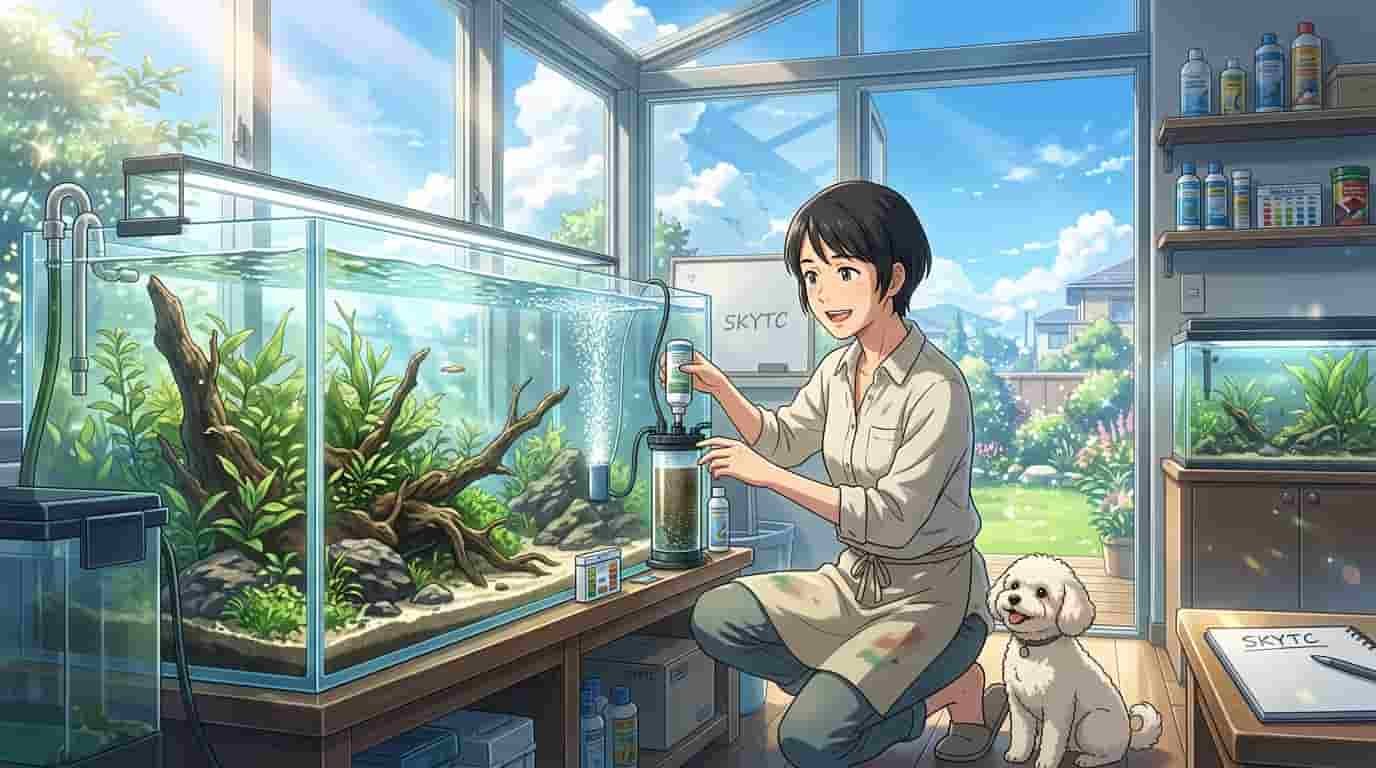
You just dropped a serious investment on a massive glass tank, dragged 400 liters of water into your home, and now you are sitting on the floor staring at an empty box. If you are desperate to figure out how to speed up large aquarium cycling without turning your future livestock into toxic waste statistics, I feel your pain. Watching cloudy water and waiting six weeks for ammonia to drop makes anyone want to snap.
I have spent eight years managing heavy-bioload freshwater setups, including my main 100-gallon display tank loaded with high-waste fancy goldfish. In my day job, I stitch custom heavy garments as a seamstress, and in my spare time, I train for long-distance road races. Whether you are running 26 miles or building biological filtration, endurance requires precise mechanics—not wishful thinking.
Stop taking bad advice from pet store clerks selling cheap bottled gimmicks that promise magic in 24 hours. By implementing battle-tested biological shortcuts, you will slash your cycle time in half, save your hard-earned cash, and lock in an indestructible nitrifying ecosystem ready for real bioloads.
30-Second Summary: The Zero-Fluff Protocol
Here is the raw diagnostic truth: You cannot skip biology, but you can force it into high gear. Raise your water temperature to 82°F (28°C), blast heavy oxygen through dual air stones, seed your filter directly with mature biomedia from a clean donor tank, and feed the system with pure pharmaceutical ammonium chloride. Throw away rotting flake food and ignore cheap “instant tank” liquids. A 100-gallon system will cycle in 7 to 10 days if you execute these exact steps without guessing. End of story.
Technical Breakdown: Aquarium Cycling Methods Evaluated
Not all cycling techniques are created equal. In a large volume setup, using slow or unreliable methods wastes time and risks complete biological collapse when you introduce heavy waste producers.
| Cycling Method | Cycle Speed (Days) | Bioload Capacity | Failure Risk | Battlefield Assessment |
|---|---|---|---|---|
| Established Biomedia Transfer | 5 – 10 Days | High (Immediate) | Low | The Good: Instantly seeds active Nitrosomonas colonies. The Bad: Can transfer parasites if sourced from an unhealthy tank. |
| Pure Ammonium Chloride Dosing | 10 – 14 Days | Extremely High | Low | The Good: Precise ppm control without fouling water clarity. The Bad: Overdosing stalls the cycle by acidifying the water column. |
| Commercial Cold-Chain Bacteria | 14 – 21 Days | Moderate | Moderate | The Good: Convenient off-the-shelf microbial boost. The Bad: Heat exposure during shipping renders cultures dormant or dead. |
| Raw Fish Food Rotting | 25 – 40 Days | Low to Moderate | High | The Good: Uses cheap household materials. The Bad: Turns water into foul, fungal soup with unpredictable ammonia spikes. |
| Fish-In Cycling (Unbuffered) | 30 – 60 Days | varies by model | Extreme | The Good: You see fish swimming on day one. The Bad: Causes severe gill burning, organ damage, and high mortality. |
Equipment & Biological Media: Real-World Gear Evaluation
When you are managing 400 liters of water volume, your filtration media is your system’s life support core. Low-grade accessories and bargain-bin components will crumble under a real bioload faster than bad seamwork under tension.
1. Sintered Glass & Porous Ceramic Rings
The Good: Provides massive internal surface area per square inch, allowing billions of nitrifying bacteria to build deep colonies.
The Bad: Cheap ceramic knockoffs break down into abrasive dust within months, grinding down your canister filter impeller blades and clogging water channels.
2. High-Density Sponge Filter Pre-Filters
The Good: Excellent dual mechanical and biological surface area that catches solid waste while supporting massive surface bacterial growth.
The Bad: Traps heavy sludge rapidly; if you do not rinse it gently in removed tank water, it restricts pump flow and starves downstream bacteria of oxygen.
3. Liquid Ammonium Chloride Drops
The Good: Delivers clean, measurable nitrogen input down to the exact drop without leaving decaying organic sludge across your substrate.
The Bad: If you lose track of your dosing math and push ammonia past 5 ppm, you will toxicity-lock your nitrifying microbes and freeze the cycle completely.
The Realities of the Battlefield
High-end canister filters and massive sump setups promise turn-key performance and crystal-clear water for display aquariums. However, standard setup manuals completely ignore how biological media behaves under real heavy-bioload stress. Cheap plastic bio-balls included in basic filter kits have almost zero internal micro-porosity, forcing beneficial microbes to live exclusively on a smooth plastic surface that washes clean under high flow.
Commercial starter bottles claim to bypass the nitrogen cycle overnight using proprietary bacterial strains. But real-world transit conditions shatter these promises. When delivery trucks sit in boiling summer heat or freezing loading docks, those sensitive nitrifying strains die en masse. You end up dumping expensive, foul-smelling dead organic matter into your tank, which spikes your initial waste instead of fixing it.
Substrate materials like live cultured sand promise immediate cycling straight out of the bag. Horizontal to this claim, the hard reality is that dense substrates compact under 100 gallons of water pressure, creating toxic anaerobic pockets that trap foul gases instead of supporting clean aerobic bio-filtration.
The “Instant Fish-In Rescue” Catastrophe
Let’s walk through a classic mistake that wrecks new setups every single week. Meet Dave. Dave sets up a shiny new 100-gallon tank, fills it with tap water, dumps a bottle of cheap starter bacteria inside, and immediately drops six large fancy goldfish into the tank. He thinks the liquid bottle acts as an impenetrable shield against metabolic toxins.
For the first 48 hours, the water looks pristine. But fancy goldfish are living waste factories. As they process high-protein meals, they dump continuous streams of pure ammonia into the water column through their gills. By day four, Dave’s undeveloped bio-filter collapses under the weight. Ammonia skyrockets to dangerous levels, turning the water into a milky white haze.
Panic takes over. Dave starts dumping random chemicals into the tank and performs frantic 80% water changes using un-dechlorinated tap water directly from the hose. The cold, chlorinated water instantly sterilizes whatever tiny bacterial colony was trying to take hold. The goldfish gasp at the surface with burnt red gills, swimming through a cocktail of raw waste. Dave ends up with dead fish, ruined substrate, and a stalled tank because he relied on marketing hype instead of biological discipline.
How to Speed Up Large Aquarium Cycling: The Tactical Blueprint
If you want to cycle a large tank at record speed without risking a total crash, you must manage four critical biological parameters: temperature, oxygen, substrate surface area, and clean nitrogen fuel.
First, crank your water temperature up to 82°F–84°F (28°C–29°C). Nitrifying bacteria reproduce at their maximum metabolic rate in warm water. Cold water slows cell division down to a crawl. Once the cycle is complete, you can dial the heater back down to your livestock’s preferred range.
Second, blast the water column with dissolved oxygen. Nitrifying microbes are strict aerobes—they consume oxygen at extreme rates while converting toxic ammonia into nitrite, and nitrite into nitrate. Drop two heavy-duty air stones attached to a high-output pump directly into the tank during the cycling phase.
Third, guard your water chemistry buffer. Nitrifying bacteria consume carbonate hardness (KH) as they process waste. If your KH drops to zero, your pH will crash below 6.5, which instantly paralyzes nitrifying bacteria. Keep your pH buffered between 7.5 and 8.0 using standard sodium bicarbonate if your local tap water is naturally soft.
When managing mature setups, feeding nutrient-dense foods—such as natural raw meat preparations and animal fats like clean beef heart mixes for specialized carnivores—produces rich metabolic waste that sustains massive bacterial colonies. However, during the initial setup phase, never throw raw meat or decaying fish food into a 100-gallon tank to cycle it. Rotting organic fat creates heavy oil slicks and foul heterotrophic bacterial blooms that choke out dissolved oxygen and stall the true nitrifying process.
Actionable Master Checklist: Fast-Tracking Your Tank Cycle
- How to speed up large aquarium cycling starts with thermal control; raise your heater setting to 82°F–84°F (28°C–29°C) to accelerate microbial cell division.
- Install high-output aeration accessories; run dual commercial air stones during the entire process to maintain maximum dissolved oxygen saturation.
- Transfer mature biomedia from a clean donor setup; move dirty ceramic rings or established sponge media directly into your new filter housing.
- Dose pure pharmaceutical ammonium chloride; bring your tank water to exactly 3 ppm ammonia using a precise liquid dropper.
- Buffer carbonate hardness (KH) above 4 dKH; add pure sodium bicarbonate if necessary to prevent acid crashes that freeze biological growth.
- Keep aquarium lighting completely turned off; nitrifying bacteria are sensitive to light exposure while establishing initial surface colonies.
- Never rinse filter media under raw tap water; municipal chlorine and chloramines instantly destroy developing biological film.
- Eliminate chemical filter media during cycling; pull out activated carbon and synthetic resins that absorb the ammonia your bacteria need for food.
- Measure parameters daily with a liquid master test kit; throw away inaccurate paper test strips that give unreliable color readings.
- Top off evaporated water with dechlorinated RO or tap water; maintain stable salinity and parameter consistency throughout the cycle.
- Verify full cycle completion with a 24-hour load test; re-dose ammonia to 3 ppm and confirm both ammonia and nitrite read zero after 24 hours.
- Perform a massive 80% water change post-cycle; clear out accumulated nitrate build-up before introducing any living fish.
- Acclimate initial livestock in small, controlled groups; give your new biological filter time to adjust to real-world waste production.
👇 Looking for more performance cheats? Check out our field-tested tactical blueprints:
The Goldfish Ecosystem Blueprint
Complete your advanced technical training loop by exploring our core evergreen resources.
How to Feed Goldfish for Maximum Lifespan
A deep breakdown of digestive tract mechanics, bloating prevention, and premium sinking diets.
How to Maintain a 100 Gallon Goldfish Tank
Large-scale system parameters. Deep sand bed mechanics, nitrogen cycling, and bioload management.
Ultimate Guide to Goldfish Tank Filtration
Heavy-duty hardware configurations. Optimizing parallel canisters, bio-media setups, and automation.
Dynamic No-Nonsense FAQ
1. Can I speed up cycling by putting feeder fish into my 100-gallon tank?
No. It is cruel, messy, and biologically inefficient. Feeder fish bring diseases, parasites, and unpredictable waste loads into a clean system. Use pure liquid ammonium chloride for precise, sterile control.
2. Does cranking up the heater really accelerate the biological cycle?
Yes. Nitrifying bacteria hit peak metabolic growth rates between 82°F and 86°F. Running a cold tank at 68°F doubles the time required to build an effective bio-colony.
3. Why did my tank cycle completely stall at high nitrite levels?
Your pH likely crashed, or your total ammonia/nitrite levels passed 5 ppm. High waste concentrations become toxic to the very bacteria trying to consume them. Perform a 50% water change to reset levels.
4. Are commercial bottled bacteria products a complete waste of money?
Most budget options are useless because the bacteria die during warehouse storage and transport. Only purchase high-grade refrigerated cultures kept in continuous cold chains by specialized suppliers.
5. Can I use dirty water from an old tank to jumpstart my new system?
No. Nitrifying bacteria do not float around freely in the water column in significant numbers. They colonize hard surfaces like porous media, sponges, and substrate. Transfer physical media, not water.
6. How do I know for absolute certain that my 100-gallon tank is fully cycled?
Dose pure liquid ammonia up to 3 ppm. If your test kit reads absolute zero for both ammonia and nitrite exactly 24 hours later, your tank is fully battle-ready.
7. Should I leave my aquarium LED lights on while cycling?
Keep them off. Nitrifying bacteria colonize faster in dark environments, and leaving strong lights on for weeks without plants will trigger a massive green water algae bloom.
8. Will live aquatic plants speed up or slow down the cycle?
Live plants absorb ammonia directly, which helps keep water safe, but they also compete with nitrifying bacteria for food. Plant heavily from day one, but keep tracking parameters with a liquid kit.
✨ Read also: Mastering the Nitrogen Cycle in High Bioload Tanks: The Raw, Field-Tested Blueprint
A deeply technical piece of content that perfectly complements this post — absolutely worth the read.