
You are sitting in a high-stakes executive conference room, watching your sleek corporate laptop freeze during a critical presentation while its internal cooling fan screams like a miniature jet engine. Big-box procurement officers and smooth-talking corporate vendor reps love to peddle ultra-thin consumer rebrands painted in corporate gray, but selecting true premium durable notebooks for enterprise employees comes down to motherboard trace density, magnesium chassis roll cages, and real-world thermal dissipation headroom.
In my repair bay, Valtersky and my dedicated support team tear down fried motherboards and crushed laptop frames every single day. I see the direct aftermath when corporate fleet buyers prioritize paper-thin vanity machines over engineered repairability: CPU voltage regulator modules cooked to a crisp, plastic display hinge anchors sheared straight out of flimsy top covers, and USB-C power delivery ports completely ripped off the main circuit board from basic daily docking strain.
Investing in heavy-duty, modular enterprise machines protects your corporate bottom line, prevents thousands of hours of IT helpdesk paralysis, and keeps your mobile workforce productive without the daily friction of system crashes. Adopting this battle-tested hardware mindset saves your organization massive sums in emergency hardware replacements, safeguards sensitive company data, and spares your staff the physical fatigue caused by thermal-throttled, poorly balanced machines.
30-Second Tech Support Counter Talk: The Zero-Fluff Verdict
Look, stop buying razor-thin consumer ultrabooks dressed up in corporate gray paint for your remote workforce. When you stuff high-wattage processors into thin sealed aluminum shells with glued-in batteries and single heat pipes, you are buying guaranteed thermal throttling and premature motherboard death. Choose magnesium-alloy internal roll cages, dual copper heat pipes, socketed memory, and modular port boards. Pay for thermal headroom and structural integrity, re-paste your cooling blocks, and dump the vanity thinness. Done.
Hardware Architecture Breakdown: Enterprise Fleet Laptop Categories
Before signing off on a massive hardware acquisition order, your IT procurement team must look past superficial sales brochures and examine structural engineering realities. Our laptop hardware specialist evaluates enterprise machines strictly on chassis torsion resistance, power phase counts, and thermal intake geometry.
| Chassis Architecture Class | Market Classification | Thermal Dissipation Capacity | Component Upgradeability | Real-World Fleet Durability |
|---|---|---|---|---|
| Magnesium-Alloy Workstation | Premium Tier Investment | Superior (Dual Copper Heat Pipes + Vented Exhaust) | High (Socketed RAM, Dual NVMe Slots) | 9.8/10 |
| Ultra-Thin Consumer Fleet Laptop | Low-Grade Components | Critical (Aggressive Thermal Throttling) | Zero (All Soldered Memory & Storage) | 2.8/10 |
| CNC Aluminum Convertible 2-in-1 | High-End Setup | Poor (Exhaust Vents Direct to Screen Hinge) | Low (Soldered RAM, Single M.2 Slot) | 4.2/10 |
| Carbon Fiber Lightweight Fleet Unit | Premium Tier Investment | Moderate (Single Blower Fan Array) | Medium (One Socketed Slot, One M.2) | 7.5/10 |
| Ruggedized Tactical Field Notebook | High-End Setup | Exceptional (Passive Heavy Sink + Sealed Blower) | Superior (Fully Modular Drive Bays) | 9.9/10 |
Why Premium Durable Notebooks for Enterprise Employees Prevent Fleet Disasters
When you deploy hundreds of laptops across a dispersed workforce, hardware reliability is not a cosmetic luxury—it is a core operational requirement. Consumer laptops are built for light home use where a machine sits on a clean desk for two hours a day. Enterprise fleet notebooks, by contrast, endure constant travel, hot vehicles, dirty coffee shop tables, and aggressive eight-hour back-to-back video conferencing loads that bake internal logic boards.
Just as an elite marathoner or strength athlete fuels their muscles and joint cartilage with nutrient-dense meat and its natural fat rather than empty synthetic fillers, high-performance mobile workstations require clean, heavy copper trace layers and unthrottled power phases to sustain relentless workloads without structural breakdown. When a laptop processor operates continuously at ninety-five degrees Celsius, cheap low-grade capacitors dry out, solder joints expand and contract until they crack, and battery pouches swell against delicate trackpad ribbon cables.
Here is how different laptop engineering designs hold up under the brutal reality of daily corporate field use:
1. Magnesium Roll-Cage Enterprise Workstations
Battlefield Assessment: Heavy-duty business machines built around an internal magnesium skeleton that absorbs external torsional twist and protects the main motherboard logic board from mechanical stress.
The Good: Exceptional chassis rigidity, dual copper heat pipes that keep CPU temperatures low, dual socketed RAM slots for simple field upgrades, and spill-resistant keyboards with dedicated bottom liquid drains.
The Bad: Noticeably thicker profile than consumer vanity machines, slightly heavier in an employee backpack, and requiring a higher initial premium tier investment.
2. Ultra-Thin Consumer-Grade Fleet Laptops
Battlefield Assessment: Flashy, paper-thin notebooks marketed to corporate buyers based on weight specs rather than structural integrity or cooling capability.
The Good: Extremely light carrying weight, sleek aesthetics that look modern in coffee shops, and low initial acquisition costs for tight budget setups.
The Bad: Single heat pipes that trigger thermal clock throttling within ten minutes, glued-in batteries that swell and crack trackpads, and completely soldered RAM that turns a single memory fault into a dead motherboard.
3. Ruggedized Modular Tactical Field Notebooks
Battlefield Assessment: Over-engineered industrial notebooks designed for field engineers, job sites, and extreme environmental conditions.
The Good: Virtually indestructible outer shells, sealed port doors that block dirt and liquid, shock-mounted storage drives, and hot-swappable dual batteries for multi-day field operation.
The Bad: Massive industrial chassis bulk, thick display bezels, heavy overall weight, and costing substantial investments per deployment unit.
The Realities of the Battlefield
Modern laptop manufacturers love boasting about sleek CNC-machined aluminum chassis and razor-thin display profiles in their glossy marketing campaigns.
However, beneath that shiny exterior lies a systemic micro-soldering engineering failure: plastic screw posts glued directly inside thin metal shells, copper heat pipes so thin they buckle under light chassis flex, and fan exhaust vents blowing hot air directly onto screen hinge adhesives.
In our repair bay, we see hundreds of business laptops killed by simple, preventable design shortcuts. Display hinges anchored into brittle plastic posts tear clean off the top cover, snapping fragile display ribbon cables and cracking the glass panel. USB-C charging ports soldered directly to the main logic board without steel strain-relief brackets break their micro-solder legs after a few months of daily cable tugging.
When an employee’s laptop dies, your business loses more than just hardware value—you lose productive billable hours, risk unbacked local data, and flood your IT helpdesk with urgent trouble tickets. Selecting enterprise gear engineered with modular daughterboards, reinforced steel port anchors, and accessible thermal assemblies gives your hardware specialist the ability to repair machines in fifteen minutes instead of waiting weeks for full motherboard replacements.
Hypothetical Failure Scenario: The Thin Ultrabook Fleet Nightmare
Imagine a growing technology company that equips its sixty sales and field engineers with ultra-thin consumer ultrabooks because they look sleek and feature attractive bulk pricing. The team works remotely, plugging heavy docking stations, dual monitors, and high-wattage power supplies into a single soldered USB-C port while running intensive database software, video calls, and browser sessions simultaneously.
Because the laptops feature single tiny heat pipes and sealed bottom panels with minimal intake grilles, the internal processors hover constantly at ninety-eight degrees Celsius. Within four months, the factory thermal paste bakes into dry, chalky crust. The internal system controller aggressively throttles CPU clock speeds down to 400MHz to prevent thermal meltdown, causing client video calls to drop, screens to lag, and compilation tasks to take twenty minutes instead of two.
To make matters worse, the constant heat bakes the internal lithium-ion battery pouches, causing them to swell against the trackpad module. Simultaneously, the mechanical strain of daily docking cable insertion breaks the solder joints on the single USB-C power delivery port. The result: forty percent of the laptop fleet becomes completely unchargeable within eight months, forcing the company to write off the entire hardware deployment and spend massive emergency funds replacing broken consumer toys with real enterprise gear.
👇 Looking for more performance cheats? Check out our field-tested tactical blueprints:
Guides for Your Next Workspace
Professional Laptops
The definitive blueprint to selecting high-performance, enterprise-grade workstations engineered to scale your productivity.
Budget Tech Tools
Practical strategies and low-cost digital tools engineered to maximize office performance without breaking your budget.
Power User Gadgets
Advanced hardware, desk automation tools, and elite tech ecosystems built to completely eliminate workflow bottlenecks.
Actionable Execution Checklist
Follow this field-tested lab macete to eliminate fleet downtime, enforce real hardware durability, and keep your corporate mobile workforce operating at maximum capacity:
- Deploy premium durable notebooks for enterprise employees with modular parts.
Pro-Tip: Selecting chassis architectures with socketed RAM and removable NVMe storage prevents complete motherboard replacement when an individual memory chip degrades. - Demand magnesium-alloy roll cages inside corporate fleet laptops.
Pro-Tip: Internal structural framing absorbs torso torque and drop impact, keeping fragile silicon dies from cracking under physical frame strain. - Inspect fan exhaust pathways to avoid screen hinge obstructions.
Pro-Tip: Vents blowing directly onto display hinges trap hot air against the panel controller, causing screen flickering and premature panel death. - Select dual copper heat pipe cooling arrays over single-pipe designs.
Pro-Tip: Dual thermal pipes spread heat evenly across primary copper fin stacks, keeping CPU and GPU temperatures below aggressive throttle limits. - Enforce dual-channel socketed memory configurations across all units.
Pro-Tip: Dual-channel RAM doubles memory bandwidth for integrated graphics, eliminating severe bottlenecking during video rendering and heavy data tasks. - Replace factory thermal paste with high-viscosity phase-change pads.
Pro-Tip: Standard low-grade thermal paste dries into brittle chalk within six months; phase-change pads maintain thermal conductivity under intense heat cycles. - Verify reinforced steel brackets around motherboard USB-C ports.
Pro-Tip: Unanchored USB-C power ports rely entirely on tiny solder joints, which shear off the motherboard after repeated docking station cycles. - Set battery charging thresholds to eighty percent capacity limits.
Pro-Tip: Capping charge limits reduces lithium-ion pouch swelling, protecting trackpads and internal ribbon cables from mechanical crush damage. - Clean internal intake grilles with compressed air every quarter.
Pro-Tip: Dust buildup forms an insulating blanket across cooling fins, forcing system fans to run at max RPM and cooking internal VRM power phases. - Choose spill-resistant keyboards with bottom drain passthroughs.
Pro-Tip: Liquid drain channels route accidental desk spills completely past the delicate logic board, turning potential liquid damage into a five-minute wipe down. - Require tool-less backplate removal for rapid field servicing.
Pro-Tip: Laptops held together with fragile plastic clips and soft Torx screws wear out quickly, slowing down IT maintenance and stripping chassis mounts.
Dynamic No-Nonsense FAQ
Are ultra-thin consumer laptops suitable for enterprise remote employees?
No. Consumer ultrabooks lack internal roll cages, use glued-in batteries, and feature single heat pipes that throttle under basic business workloads. They are built for light home use, not eight-hour daily corporate grinds.
Why do enterprise fleet laptops slow down during long video conference calls?
Thermal throttling. Video conferencing software forces the CPU and integrated GPU to run continuously. If the cooling assembly cannot exhaust that heat fast enough, the processor drops clock speeds to prevent physical destruction.
Is soldered RAM really a deal-breaker for business laptop durability?
Yes. Memory chips degrade over time under thermal stress. If RAM is soldered directly to the motherboard, a single memory fault permanently bricks the entire machine, forcing costly total motherboard replacements.
Why do USB-C charging ports fail so frequently on modern laptops?
Manufacturers solder USB-C ports directly to the motherboard without installing secondary steel anchor brackets. Daily cable movement creates mechanical leverage that cracks the micro-solder pins right off the board traces.
How does internal magnesium framing protect laptop motherboards?
Magnesium roll cages act as an internal skeleton. When an employee lifts a laptop by one corner or drops a bag, the magnesium frame absorbs the twisting force instead of transferring that flex directly into fragile silicon dies.
Are expensive extended warranties worth buying for business laptop fleets?
Not if you buy true modular enterprise laptops. If your hardware features socketed parts and removable port boards, your in-house IT team can repair failures in fifteen minutes for a fraction of warranty contract costs.
Why do laptop batteries swell and warp the lower palm rest?
Constant high thermal exposure combined with keeping the battery locked at 100% charge generates gas inside lithium-ion pouches. Swelling batteries push against trackpads and can puncture internal ribbon cables.
Can re-pasting factory thermal compound actually fix thermal throttling?
Absolutely. Factory thermal paste is applied cheaply in mass-production lines and bakes into a dry crust within months. Applying high-viscosity carbon paste or phase-change pads can drop temperatures by ten degrees instantly.
Why Trust SKYTC Curated Gear?
At SKYTC, we simplify technology for you. We aren’t just another deals site; we are hardware experts obsessively focused on elite performance.
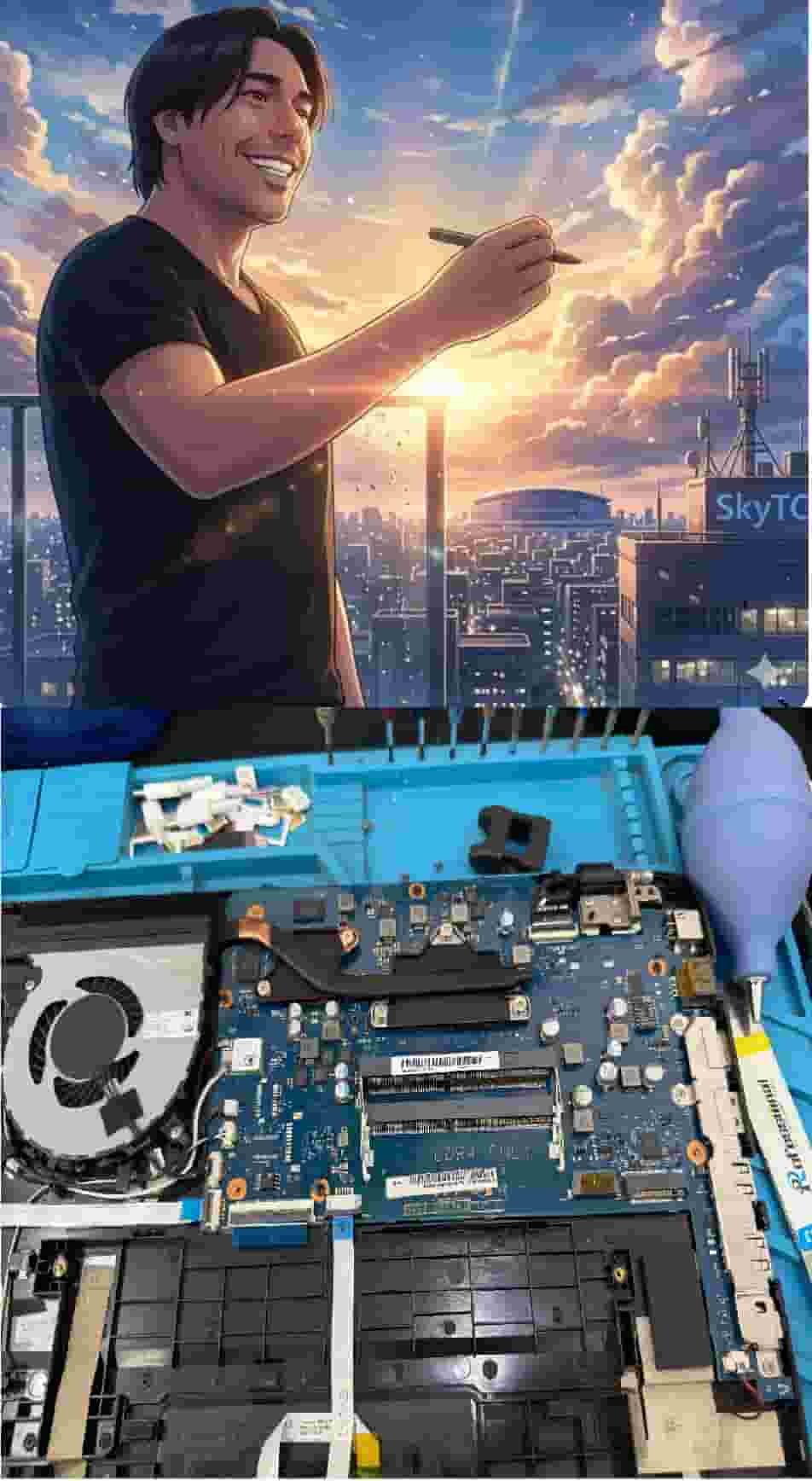
Technical Bio: Hardware & Laptops
“At SkyTC, technology is driven by engineering precision and real field experience. I am Valtersky, and I bring a unique background to the bench: from professional woodworking, the eye for structural integrity; from radiology, an absolute obsession with microscopic details.
As an ultra-endurance marathon runner, I don’t just browse store windows. I tear machines down, run intensive stress tests on thermal dissipation, and validate the actual build quality of every single component. My mission is to translate complex tech engineering and tech finances into smart decisions for your workflow.
Here, we speak straightforward, jargon-free English with the authority of someone who knows exactly what is inside the chassis.”
✨ Read also: (Heavy Duty Work Laptops Built to Last for Tech Teams: Hardware Architect’s Guide)
A deeply technical piece of content that perfectly complements this post — absolutely worth the read.