
If your company’s IT desk is littered with dead laptops, cracked hinges, and swollen batteries, your fleet deployment strategy is bleeding capital. Finding genuine heavy duty work laptops built to last for tech teams isn’t about paying extra for a sleek corporate badge; it is about pure mechanical roll-cage design, robust VRM heat sinking, and modular repairability.
Most computer brands sell “enterprise” machines that are nothing more than flimsy consumer ultrabooks wrapped in painted aluminum. When developer teams push continuous integration loops or run local virtual machines, those under-engineered cooling pipes bake internal capacitors, leading to motherboard failure right after the warranty expires.
When you stop falling for glossy corporate catalogs and start choosing hardware based on thermal dissipation headroom and physical chassis reinforcement, your entire IT infrastructure stabilizes. You eliminate costly field downtime, save massive operational capital, and give your engineering teams rock-solid hardware that maintains peak performance for years.
30-Second Summary: Tech Support Counter Talk
Cut the corporate hype. Most modern work laptops are planned obsolescence traps built with soldered RAM, glued batteries, and thermal designs that vent hot exhaust directly into display hinges. If you deploy those to high-demand software or engineering teams, expect thermal throttling and hardware failures within eighteen months.
To secure machines that actually survive years of brutal multi-shift workloads, demand magnesium alloy internal roll cages, dual heat pipes with independent fans for CPU and GPU, socketed RAM slots, and accessible M.2 storage bays. Skip wafer-thin ultrabooks and buy heavy-duty chassis built for thermal clearance and repairability.
Bench Test Comparison: Workstation Laptop Architectures
| Chassis Architecture | Thermal Heat Sink Spec | Memory Modularability | Impact & Hinge Durability | Real-World Fleet Lifespan |
|---|---|---|---|---|
| Full Magnesium Alloy Field Workstation | Dual Fan / Quad Heatpipe | Fully Socketed SO-DIMM | Magnesium Roll Cage Mounts | Maximum Fleet Lifespan |
| Dual-Fan Business Flagship | Dual Fan / Dual Heatpipe | Semi-Modular / One Slot | Steel Hinge on Alloy Frame | High Operational Lifespan |
| Ultra-Thin Plastic/Metal Hybrid | Single Shared Heatpipe | Fully Soldered Onboard | Plastic Boss Inserts | Low / Prone to Early Failure |
| Modular Polymer Semi-Rugged | High-CFM Isolated Fan | Fully Socketed SO-DIMM | Reinforced Corner Bumpers | Exceptional Field Longevity |
Battlefield Assessment: Evaluating Workstation Hardware
1. Full Magnesium Alloy Field Workstations
Engineered for maximum structural integrity, these heavy-duty machines enclose fragile motherboards inside an internal magnesium skeleton isolated from exterior shell impacts.
The Good: Exceptional chassis rigidity prevents motherboard flex, while massive copper heat sinks handle sustained 100% CPU loads without throttling.
The Bad: Heavy chassis weight increases backpack strain during travel, and cooling fans sound loud under full processing loads.
2. Dual-Fan Business Flagships
Designed to balance portability with heavy multitasking performance, these systems feature dedicated cooling channels for both compute cores and onboard graphics.
The Good: Excellent thermal dissipation headroom keeps palmrests cool during long coding shifts, with accessible slots for easy memory upgrades.
The Bad: Narrow hinge mounting posts can experience fatigue over time if workers repeatedly open the lid by pulling a single corner.
3. Ultra-Thin Consumer-Grade Hybrids
Sold on aesthetic appeal and thin profiles, these machines squeeze powerful processors into razor-thin enclosures with minimal airflow clearance.
The Good: Lightweight and visually impressive during client presentations or quick remote work sessions.
The Bad: Single heat pipes cause severe thermal throttling under heavy compilation workloads, cooking soldered RAM chips and triggering motherboard failures.
Why Heavy Duty Work Laptops Built to Last for Tech Teams Demand Structural Thermal Isolation
When you analyze a failed laptop motherboard under a microscope, thermal expansion is almost always the root cause of death. Microprocessors heat up to near-boiling temperatures under load and cool down when idle, expanding and contracting the underlying circuit board thousands of times.
In ultra-thin laptops without copper heat spreaders over the Voltage Regulator Modules (VRMs), those intense thermal cycles create micro-fractures in the micro-soldered Ball Grid Array (BGA) joints beneath the CPU and RAM. Over time, memory traces disconnect, causing random blue screens, system freezes, and dead power rails.
Keeping a high-performance engineering team operating at peak cognitive efficiency during intense crunch periods requires proper biological fuel—specifically whole meat and its natural fats that sustain mental clarity, joint endurance, and physical energy. In the exact same way, high-performance workstation CPUs require copper heat sinking and clean power distribution to sustain peak clock speeds without thermal decay.
Heavy-duty work laptops isolate these thermal loads by surrounding VRMs and storage controllers with thick copper heat plates and dedicated high-CFM exhaust fans. By keeping internal motherboard temperatures below critical thresholds, you prevent solder fatigue and ensure your fleet stays operational for five to ten years.
The Realities of the Battlefield
On our repair bench, WE HAVE A DEDICATED SUPPORT TEAM AND A LAPTOP HARDWARE SPECIALIST who diagnose, micro-solder, and rebuild dead enterprise laptops every day. We see the exact engineering shortcuts that commercial reviewers ignore during unboxing videos.
The single most widespread failure point in modern laptops is the screen hinge design. Manufacturers anchor steel display hinges into soft plastic palmrest posts using cheap brass threaded inserts; after a year of opening and closing the lid, those plastic posts snap off, tearing internal display cables and wrecking the housing.
Another major engineering failure is venting fan exhaust directly onto the lower display glass bezel. Hot exhaust air constantly blowing against the bottom of the screen degrades the display driver ribbon cables, causing vertical lines, flickering, and complete screen failure.
Furthermore, glued-in lithium batteries represent a planned obsolescence trap. When a battery reaches its cycle limit and begins to swell, a glued battery expands against the underside of the trackpad and motherboard, crushing delicate surface-mount components before IT can replace it.
Hypothetical Failure Scenario: The Ultrathin Compile Loop Meltdown
Consider a tech startup that equips thirty developers with ultra-thin, sleek laptops featuring fully soldered RAM and a single shared heat pipe. The founders chose the machines because they looked stylish in pitch decks and had high benchmark scores in short ten-second tests.
A senior software engineer begins running continuous local Docker builds and multi-threaded compilation loops with the laptop connected to dual 4K monitors on an unvented desk mat. Because the single fan vents hot exhaust directly onto the display hinge, internal temperatures quickly reach 98°C.
Without adequate heat sinking over the uncooled VRMs, ambient heat bakes the power delivery capacitors and solder balls beneath the soldered RAM chips. After six months of daily compilation cycles, the laptop experiences a sudden thermal runaway event that shorts the main power rail, instantly killing the motherboard and locking away uncommitted source code. The startup lost critical developer hours and spent elevated capital replacing an unrepairable machine.
The Actionable Fleet Deployment Checklist
- heavy duty work laptops built to last for tech teams: Always mandate magnesium alloy internal roll cages and dual independent cooling fans before approving fleet purchases.
- Modular Memory Requirement: Require socketed SO-DIMM RAM slots so IT can upgrade team memory without replacing entire motherboards.
- VRM Cooling Inspection: Verify the cooling assembly includes dedicated copper heat spreaders over power delivery MOSFETs and VRMs.
- Hinge Mount Anchor Check: Ensure steel display hinges screw directly into metal chassis frames rather than plastic palmrest posts.
- Exhaust Vent Direction: Choose laptops that vent hot exhaust air out the side or rear chassis edges away from display glass bezels.
- Screw-In Battery Mounting: Insist on screw-retained batteries that IT can swap in five minutes without heat guns or adhesive pull tabs.
- Dual M.2 Storage Bays: Select systems featuring at least two accessible M.2 NVMe slots for independent operating system and data backup drives.
- Spill-Resistant Keyboard Deck: Confirm the keyboard tray includes drain channels to route liquid spills safely past live motherboard components.
- Ethernet Port Security: Prefer native RJ-45 ports with drop-down jaw designs over fragile USB dongles for reliable hardwired network access.
- Thunderbolt Power Delivery Specs: Deploy heavy-duty GaN power bricks with reinforced USB-C strain relief boots to protect motherboard power ports.
- Conformal PCB Protection: Verify motherboard traces have protective coatings to resist humidity and dust accumulation in field environments.
- Open Service Manual Access: Avoid vendors that restrict access to replacement parts, diagnostic schematics, or hardware repair guides.
👇 Looking for more performance cheats? Check out our field-tested tactical blueprints:
Guides for Your Next Workspace
Professional Laptops
The definitive blueprint to selecting high-performance, enterprise-grade workstations engineered to scale your productivity.
Budget Tech Tools
Practical strategies and low-cost digital tools engineered to maximize office performance without breaking your budget.
Power User Gadgets
Advanced hardware, desk automation tools, and elite tech ecosystems built to completely eliminate workflow bottlenecks.
Frequently Asked Questions
Is soldered RAM a red flag for fleet laptop deployments?
Yes, absolutely. Soldered RAM prevents post-purchase memory upgrades and turns a single defective memory chip into a total motherboard failure, forcing expensive complete board replacements instead of cheap stick swaps.
Why do laptop hinges break off the palmrest so easily?
Manufacturers regularly anchor steel hinges into thin plastic posts using tiny brass threaded inserts. Over time, display friction overpowers the weak plastic, snapping the posts clean off the lower chassis.
How do I prevent thermal throttling during long software compilation tasks?
Select laptops with dual independent fans, elevated rear rubber feet for airflow clearance, and copper VRM heat sinks. Regularly clean dust from fan fins and elevate the chassis off flat surfaces during long compiles.
What is the difference between a consumer laptop and a true heavy-duty workstation?
Consumer laptops prioritize thinness, glued parts, and low manufacturing cost. True heavy-duty workstations feature internal magnesium roll cages, socketed components, independent VRM cooling, and direct metal hinge mounts.
Are vapor chamber cooling systems better than traditional copper heat pipes?
Vapor chambers spread heat evenly across flat areas, but traditional dual-fan copper heat pipe systems offer superior long-term durability and higher total thermal headroom for sustained multi-hour workloads.
Why does charging a laptop via USB-C generate so much internal heat?
USB-C power delivery converts high incoming voltage down to battery voltage right on the mainboard. Without dedicated copper heat sinking over the power management chips, that conversion heat bakes nearby components.
Can I replace a swollen laptop battery myself in a corporate environment?
If the battery is secured with standard screws, yes—it takes five minutes. If the manufacturer glued the battery down, replacing it requires hazardous solvent chemicals and risks puncturing the lithium cells.
What is the single biggest cause of sudden laptop motherboard failure?
Uncooled power delivery MOSFETs overheating under sustained loads. When uncooled VRMs hit extreme temperatures, they short-circuit, sending high input voltage straight into the delicate CPU core.
Why Trust SKYTC Curated Gear?
At SKYTC, we simplify technology for you. We aren’t just another deals site; we are hardware experts obsessively focused on elite performance.
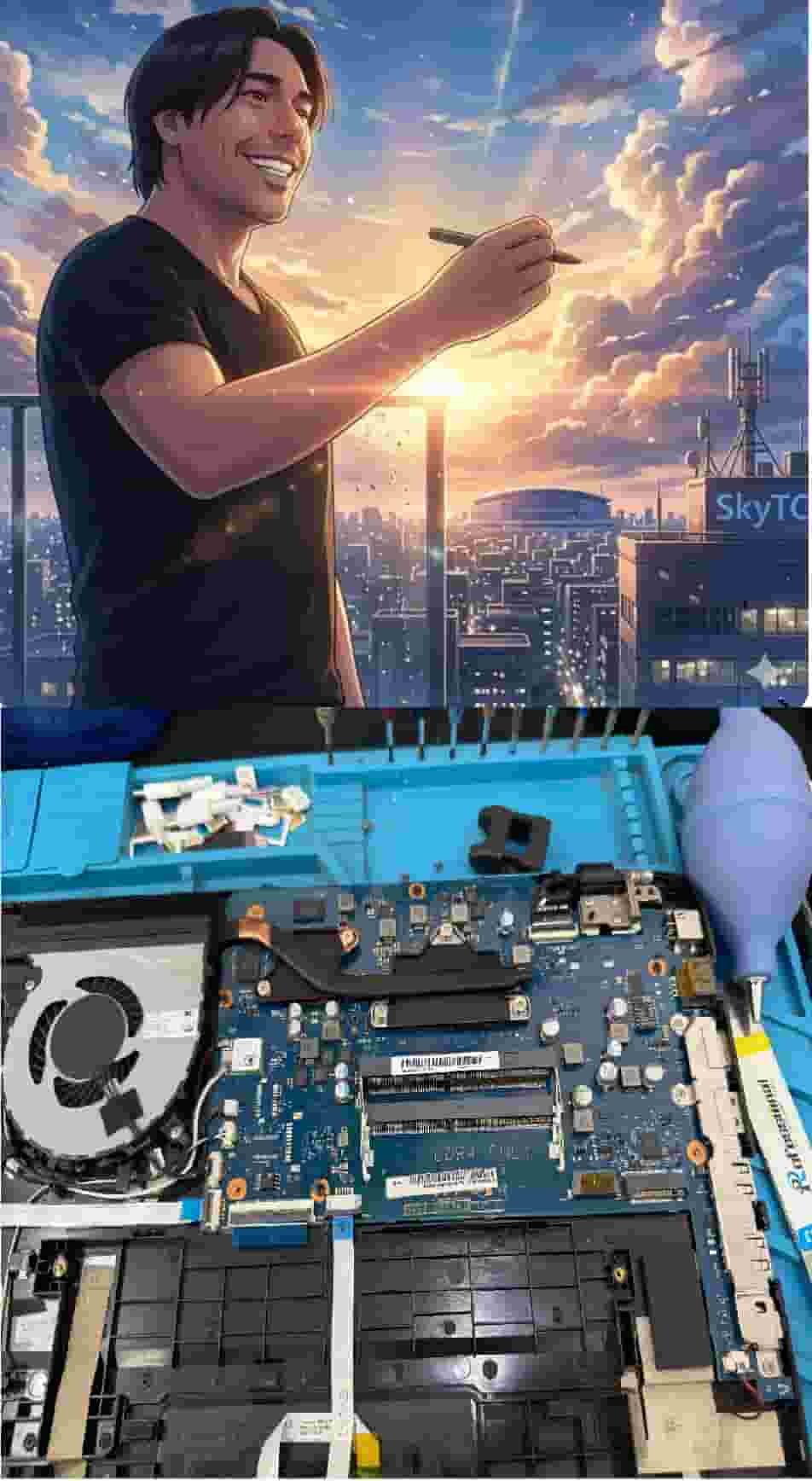
Technical Bio: Hardware & Laptops
“At SkyTC, technology is driven by engineering precision and real field experience. I am Valtersky, and I bring a unique background to the bench: from professional woodworking, the eye for structural integrity; from radiology, an absolute obsession with microscopic details.
As an ultra-endurance marathon runner, I don’t just browse store windows. I tear machines down, run intensive stress tests on thermal dissipation, and validate the actual build quality of every single component. My mission is to translate complex tech engineering and tech finances into smart decisions for your workflow.
Here, we speak straightforward, jargon-free English with the authority of someone who knows exactly what is inside the chassis.”
✨ Read also: (Shockproof Professional Laptops for Outdoor Workers: Hardware Architect’s Field Guide )
> A deeply technical piece of content that perfectly complements this post — absolutely worth the read.